


The Simpson Desert Expedition

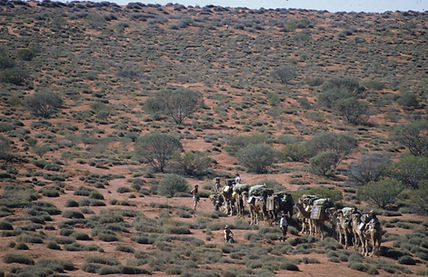
The 2006 30th Anniversary Simpson Desert Expedition approaches Birdsville on the final day (26) of walking
50th Anniversary Simpson Desert Expedition
Australia’s greatest - and most challenging - desert walk returns
In tribute to Outback pioneer Rex Ellis, whose vision shaped a generation of desert travellers
And commemorating:
The 90th Anniversary of Ted Colson's 1936 Simpson Desert crossing
The 140th Anniversary of David Lindsay's 1886 Great Central Exploration Expedition
34 Days - May 10 > June 12 2026, 1 day 4WD/1 day pre-departure/30 days trekking/1 day in Birdsville/1 day flight Birdsville to Brisbane
Expedition price: $20400 - includes 2 nights accommodation in Birdsville, Expedition dinner at the Birdsville Hotel, Birdsville to Brisbane flight with REX Airlines, commemorative Expedition shirt, commemorative 50th Anniversary Expedition souvenir
Maximum group size: 10 Expedition Members
Expedition Crew: 5 cameleers plus the Expedition Doctor
Camels: 17
If you are interested in joining this journey, please contact Andrew Harper via email on andrew@desertexpeditions.org

SDE 2006: The Expedition encountered very dry conditions on the eastern side of the desert. Photo - Josef Schofield
Celebrating a half-century of adventure, endurance, and connection to Country.
Great Desert Walks is the banner under which the Outback Camel Company and Australian Desert Expeditions conduct their respective desert trekking operations. And 2026 marks a milestone year for the Outback Camel Company, the 50th Anniversary of Australia’s original desert camel-trekking enterprise.
It all began in the late summer of 1976, when Rex Ellis started leading camel treks through the Flinders Ranges before attempting something truly audacious: a full crossing of the Simpson Desert that winter. No one had made such a journey since Cecil Madigan’s 1939 expedition.
Concluding outside the Birdsville Hotel, the 1976 crossing became Australia’s first commercial camel expedition, firmly establishing Rex Ellis as a pioneer of adventurous outback tourism.
Today, we continue Rex’s vision for “getting out there and having a go,” and we are extremely proud of our cameleering heritage.
The guiding ethos of all our treks remains the same as it was on that first Simpson Desert expedition in 1976: simplicity, slowness, respect for Country, and a willingness to be changed by the power of the landscape and the remarkable personalities of the camels who walk beside you.

SDE 2002: the Expedition approaches Birdsville on day 26. Photo - A Harper
What is the SDE, and why is it so challenging?
Outback Camel Company owner & Expedition Leader Andrew Harper explains...
Having walked across the Simpson Desert more than a dozen times since 1995 (both solo and leading Outback Camel Company expeditions) I can say with certainty that the Simpson Desert Expedition (SDE) is a demanding journey.
For humans. And for camels.
Recently, I walked 980 kilometres across the Andes, pulling a small cart, staying on roads, ascending the three main great mountain ridges, and climbing to an eventual 4,090 metres. It was a genuinely difficult journey.
Yet despite the vast difference in terrain, the Simpson Desert Expedition shares one defining similarity:
You walk uphill most of the way.
Each day begins by ascending the gradual slope of the first dune, then descending the steep eastern face, only to begin the long, unhurried & steady climb up the next. And then the next. And the next. This quiet rhythm continues for hundreds of kilometres across the world’s largest parallel sand-ridge desert.
There is no drama in it. No single summit. Just a patient, repeated ascent.
It was because of this that my late friend, the pioneering adventurer Warwick Deacock, described the SDE as “Australia’s Horizontal Mount Everest.”
And he also understood something important.
The challenge is not explosive. It is cumulative. It asks you to keep going. To accept occasional discomfort. To find steadiness rather than speed. To accept the rhythm of the dunes rather than resist it. And to fall into the pace of the camels who are carrying our gear.
Somewhere out there, usually around day ten, or fifteen, something shifts. The dunes stop being obstacles and begin to feel like companions. The landscape stops seeming harsh and reveals itself as ancient, immense, and quietly generous.
But here is the truth:
Very few people will ever walk the Simpson Desert on foot. Fewer still will cross it without roads, without vehicle support, and in the quiet company of camels.
For those prepared to take it on, the SDE is not simply a long trek, it is a defining journey. A rare opportunity to test yourself in one of Australia’s most remote landscapes and to be changed by it. It is a reminder of what sustained effort feels like.
Of what silence can reveal.
Of how capable you truly are.
And when it is over, you will not have conquered the desert.
You will have walked with it.
If you are looking for something comfortable, this expedition will disappoint you.
If you are looking for something meaningful, and growth, depth, and quiet endurance matter more, this might be exactly what you’ve been searching for.

SDE 2004 The camels cross the gibber plains on the eastern side of the desert. Photo - A Harper
I’ve never walked on a camel trek before - is the SDE too much for a first-timer?
My first ever camel trek (and my introduction to camels) was on the 1995 SDE. Rex Ellis was leading the trip, and it was an enormous adventure. Coming from a background working with animals, I slipped into the camel husbandry side of things easily, but even so, the 400-plus kilometres trekking across the desert was the most I had ever walked in my life.
So, while a capable first-time trekker could complete the SDE, depending on your preparation, my strong advice is not to jump straight in at the deep end. The SDE is a demanding journey, physically and mentally, and it may be better to begin with a shorter trek to learn the rhythms of desert walking, camel work, and life out bush.
Build your foundation first, then take on Australia’s Horizontal Mount Everest.

SDE 1995: Navigator Peter Jeffery plots the course. The camel sting halts whilst ascending a dune. Photos - A Harper
What preparation is required?
With roughly 430 km to walk across sand dunes in 30 days, the SDE is unquestionably a physical challenge.
Over the course of such a journey, I’ve shed excess kilos and toned up considerably. I remember arriving in Birdsville after the 2001 SDE, 9 kilos lighter than when I started...
But it’s important to remember that although the total distance is considerable, this is Slow Travel. We move at camel pace, plodding steadily along day after day. We can only go as fast as the camels, and they keep a consistent, unhurried rhythm.
The days, however, will be long. We aim to set off as early as possible because no matter when we start, we must make camp at roughly the same time each afternoon, giving the camels enough daylight to feed adequately.
And, as is the nature of long expeditions, some days will inevitably be longer than others, as unforeseen circumstances will inevitably add to the challenge.
The Physical Side
You will need:
• A solid walking foundation
• Good joint mobility
• The stamina to walk day after day on sometimes uneven, sandy terrain
• The ability to manage mild heat, dust, and repetitive dune climbing
The Mental Side (the real key)
Physical fitness is only half the preparation. The other half is mental readiness, the willingness to be out there for 30 days, adjusting to the rhythm of desert life, sleeping in a swag, walking, and embracing the simplicity and repetition of each day.
This mindset is crucial. It is what makes a successful expedition member.
A note on logistics and commitment
While we have a detailed evacuation plan for genuine medical emergencies, the SDE is not a trip where you can simply decide, “I’ve had enough and I want to go home.”
Because on the SDE, you can’t. Once you commit and join the expedition, you become part of the team, and you’re there for the duration.
On past expeditions, we carried everything we needed for the entire journey on the camels. But years of experience have taught me to now approach the logistics more sensibly. For the well-being of the camels, I now arrange a water resupply dump en-route, a practical refinement that supports both the animals and the team.
Photo - Carolyn Larcombe


SDE 2004: It was a dry desert! Photos - A Harper
Other long-distance walks such as the Larapinta (220 km), the Camino (800 km), Tasmania’s Overland Track (65 km), or the Bibbulmun Track (1,000 km) can certainly be challenging, depending on a walker’s fitness and preparation.
But the SDE differs from all of these in one profound and essential way: those walks follow a defined path, whether a track, a trail, or even a boardwalk, and you will see other walkers almost every day.
The Simpson Desert Expedition is an entirely different experience.
We walk cross-country, not on tracks.
We will not see other people.
There are no backup 4WDs, no support vehicles, no roads or tracks (aside from the very last day into Birdsville).
Once we step over that first dune, the desert becomes our entire world, and we become part of its world.
This is what makes the SDE one of Australia’s most unique and profound walking journeys.
The SDE is not 30 days of disconnection: it is 30 days of genuine reconnection.
Life-changing? Most probably.
Physically demanding? Definitely.
And beyond that… the experience holds countless moments and insights that are simply too difficult to put into words.
Andrew Harper
Owner, Outback Camel Company & Expedition Leader
Photo - Carolyn Larcombe

The SDE is a journey for those who seek something deeper: a test of endurance, a reconnection with the natural world, and an immersion into one of Australia’s most extraordinary landscapes. It demands commitment, but it gives back far more than it ever takes. For the right person, this is not just a walk: it’s a defining life experience.
Where Are We Walking?
We will be walking across the Simpson Desert in the Northern Territory and Queensland.
The Simpson is the world's largest parallel sand-ridge desert, covering approximately 173,000sq kms, and extending to the northern shores of Kati-Thanda Lake Eyre in South Australia.
We will begin the journey near the Finke River floodplain and trek (in a wobbly line) more or less due east until we reach Big Red, where we will then change course and make straight for Birdsville, avoiding as much as possible & practical the roads.
Once we near Queensland, we enter Munga-Thirri, Big Sandhill Country, the traditional land of the Wangkangurru people, many of whom reside in Birdsville.
And as we approach Eyre Creek we are on Adria Downs Station, home to the Brook family. This 8,750-square-kilometre cattle station, established in 1912, operates on organic management principles. Please note that Adria Downs is an active cattle station and we may encounter evidence of cattle during the latter stages of the expedition, though at 8,750 square kilometres, any encounter would be brief and sparse.
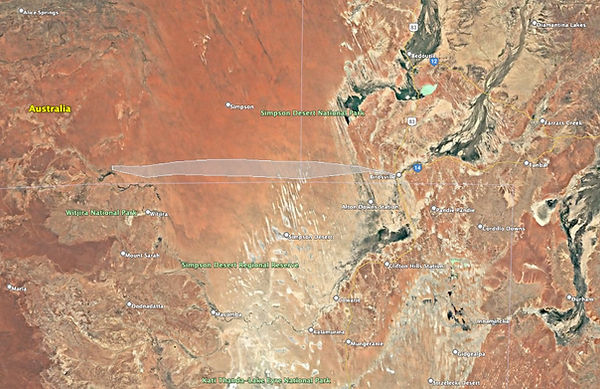
The shaded area on the map below shows the corridor in which we intend to walk, though the exact route will be determined closer to departure, once we consider the impact of any local rain events over the forthcoming summer.


What's included
4WD transfers from Alice Springs to the Simpson Desert
Accommodation in Birdsville on June 10 and 11. Dinner at the Birdsville Hotel on June 10. Rex Airline flight from Birdsville to Brisbane on June 12. Commemorative Expedition shirt, commemorative 50th Anniversary Expedition souvenir
All camping equipment - swags, stools, tents. You bring your own sleeping bag and eating utensils
All meals, though we do not provide snacks
LOTS of space...
RFDS Medical Chest and emergency communications equipment
Crew of 5 cameleers
Expedition Doctor
Desert Silence!
Trekking with an environmentally aware responsible business
(A detailed Expedition Information Guide is sent to you when you book)
What's not included
Pre expedition airfares and accommodation to/in Alice Springs. You are responsible for arranging your travel to Alice Springs and any accommodation. We can help organise this for you
What else is recommended?
Travel Insurance. You have the option to arrange your own travel insurance, or you can contact us for a quote.